
Beyond the Citadel: Is Cusco and Machu Picchu Worth It Compared to Other South American Icons?
When international travelers begin planning an bucket-list journey to South America, they almost instantly encounter a common dilemma: Which region deserves their limited vacation days? Should you hike through the remote, windswept peaks of Patagonia, explore the dense biodiversity of the Amazon basin, or immerse yourself in the living history of the Peruvian Andes?
While every corner of South America offers extraordinary beauty, the region surrounding Cusco, the Sacred Valley, and Machu Picchu stands in a league of its own. It is one of the few destinations on the planet where archaeological wonders, world-renowned gastronomy, diverse microclimates, and vibrant indigenous culture converge seamlessly.
In this comprehensive guide, we unpack the true difference between visiting Cusco vs. other South American travel hubs, break down the relationship between Cusco and Machu Picchu, and provide essential insider logistics for a seamless high-altitude adventure.
Comparing South American Icons: Why the Peruvian Andes Stand Out
To understand why Peru’s Andean heartland remains the premier choice for world travelers, let’s compare its experience with other legendary South American destinations.
| Destination | Primary Appeal | Accessibility & Infrastructure | Cultural Depth | Ideal Traveler |
| Cusco & Machu Picchu (Peru) | Ancient archaeology, living Inca culture, world-class gastronomy | Excellent rail networks, boutique luxury lodges, short transit times | Very High: Centuries of combined Inca, Spanish colonial, and Quechua traditions | Culture seekers, foodies, history buffs, luxury & soft-adventure travelers |
| Torres del Paine / Patagonia (Chile/Argentina) | Dramatic mountain landscapes, glaciers, extreme wilderness trekking | Requires long overland transfers, unpredictable sub-polar weather | Moderate: Focused primarily on natural geography and expedition history | Hardcore trekkers, wilderness photographers, outdoor purists |
| The Amazon Basin (Brazil/Peru/Ecuador) | Deep jungle biodiversity, wildlife tracking, river cruising | High logistics requirements, remote boat transfers, humid tropical climate | Moderate: Indigenous communities with restricted access | Nature lovers, birdwatchers, eco-tourists |
While Patagonia offers raw wilderness and the Amazon offers deep nature, Cusco and Machu Picchu provide a complete human and natural story. You don't just look at scenery; you walk through stone temples constructed with microscopic precision, eat at restaurants ranked among the world's best, and interact with local weavers keeping thousand-year-old textile techniques alive.
Cusco vs. Machu Picchu: Understanding the Relationship
A frequent misconception among first-time visitors is treating "Cusco" and "Machu Picchu" as interchangeable terms. In reality, they represent two distinct geographic environments, elevations, and travel experiences that complement each other.
1. Cusco: The Ancient Imperial Capital
Sitting at 11,152 feet (3,399 meters) above sea level, Cusco was the capital of the Inca Empire (Tawantinsuyu). Today, it is a bustling UNESCO World Heritage city where Spanish colonial churches sit directly atop fine Inca stonework foundations.
The Vibe: Vibrant nightlife, cobblestone alleys, artisan markets in San Blas, and high-end dining.
Why it matters: Cusco is the cultural backbone of your trip. Skipping Cusco means missing the context of how the Inca Empire governed millions of people across western South America.
2. The Sacred Valley: The Agricultural Engine
Nestled between Cusco and Machu Picchu lies the Sacred Valley of the Incas (Valle Sagrado). Located at a lower altitude (around 9,000 feet / 2,740 meters), this fertile valley carved by the Urubamba River features agricultural ruins like Moray, salt terraces at Maras, and fortress towns like Ollantaytambo.
The Vibe: Peaceful, rural, surrounded by towering Andean peaks, ideal for acclimatization.
3. Machu Picchu: The Royal Estate & Citadel
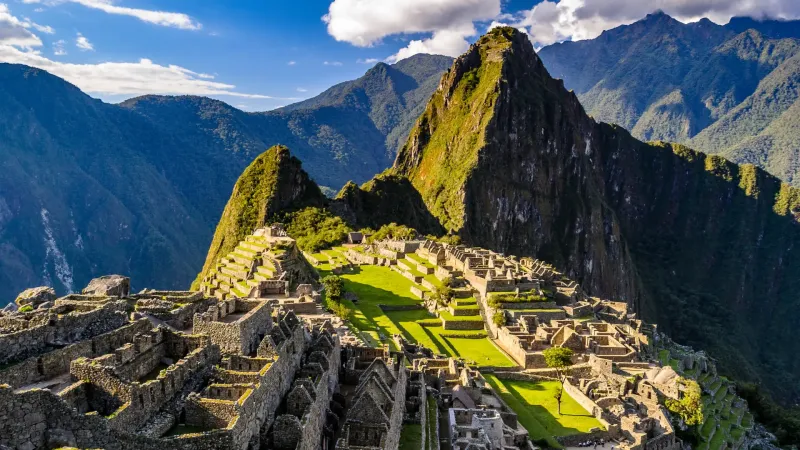
Positioned at 7,972 feet (2,430 meters), Machu Picchu is actually lower in altitude than Cusco. Nestled in a high-cloud forest where the Andes meet the Amazon basin, this 15th-century estate constructed under Emperor Pachacuti remains an architectural marvel.
The Vibe: Mystical, dramatic, and humbling.
Essential Logistics: How to Plan Your Journey
Planning a seamless trip to the Andes requires strategic timing and advance bookings due to strict conservation regulations.
The Circuit System at Machu Picchu
To preserve the stone architecture, local authorities enforce fixed visitor entry circuits.
Panoramic Circuits: Perfect for classic postcard photography from the upper terraces.
Classic & Historical Circuits: Take you through the heart of the urban sector, Sacred Plaza, and Sun Temple.
Adventure Routes: Include hikes up Huayna Picchu or Machu Picchu Mountain for panoramic bird's-eye views.
Note: Tickets sell out months in advance. Securing entry passes 3 to 4 months ahead is highly recommended.
Managing High Altitude (Soroche)
The biggest technical challenge for travelers visiting the Peruvian Andes is altitude adaptation.
Fly into Cusco, but descend immediately: Upon landing in Cusco, head straight down to the Sacred Valley for your first 2–3 nights.
Stay hydrated: Drink plenty of water and traditional coca tea.
Pace yourself: Keep physical exertion light on Day 1 and avoid heavy meals or excessive alcohol initially.
